


High time for lynx in Alaska鈥檚 Interior
January 14, 2021
Ned Rozell
907-474-7468
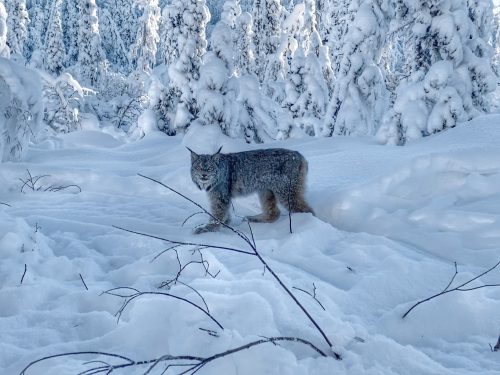
Mike Taras has worked for the Alaska Department of Fish and Game for many years, but this is the first time he has said the words 鈥渘uisance lynx.鈥�
Taras, a wildlife education and outreach specialist, said people are seeing a lot of lynx in Alaska鈥檚 Interior.
鈥淚 don鈥檛 remember people calling in telling us about lynx getting chickens and attacking cats and dogs,鈥� Taras said.
Canada lynx are wild northern cats found through most of Alaska. The long-legged creatures pad through the entire sweep of the boreal forest, all the way to the Atlantic coast of Canada. The felines that leave behind perfect-circle tracks in the snow are the perfect predator of the snowshoe hare.
When snowshoe hare numbers are high, lynx often have more kittens, Taras said. When hares are on the downward slope of their mysterious 10-year-cycles, lynx probably know it first.
鈥淭hey鈥檒l switch to alternative food (like red squirrels and grouse), but there鈥檚 not enough of it,鈥� he said.
Tony Hollis, a co-worker of Taras, is the department鈥檚 area biologist for several wildlife units in the middle of Alaska that add up to be the size of Maine. He recently responded to a call from a person whose dog had battled a lynx. The dog survived the scrap, but required an expensive trip to the vet. Hollis euthanized the injured lynx.
鈥淚鈥檝e been at this job since 1999, and it鈥檚 the first time in my career I鈥檝e had to do that,鈥� Hollis said.
Hollis asks trappers 鈥� who often come to him to 鈥渟eal鈥� the hides of lynx they have caught 鈥� whether they have trapped young lynx or have seen tracks of mother lynx with kittens (born this fall). He has gotten no reports of young lynx.
鈥淓ither they didn鈥檛 have a litter, or the kittens died or were killed prior to winter,鈥� Hollis said. 鈥淚t鈥檚 kind of the first step in the crash of the lynx population. The kittens go away first.鈥�
People around Fairbanks have reported lynx calmly looking at them from packed snow trails and have wondered if something is wrong with them. Taras said that is probably normal behavior for lynx.
鈥淢ost people never see a lynx,鈥� he said. 鈥淚 think when they sit and stare at you they are just maybe checking things out.
鈥淯sually, people don鈥檛 encounter them, but maybe they are moving around a lot, searching for food,鈥� he said.
Taras said he has seen lynx tracks right outside his home in Fairbanks this year, and he just found signs in the snow of one lynx eating another on a recent trip he took to the Alaska Range. He sees that as evidence that lynx will have a tough time until the numbers of snowshoe hares increase, but added that this is a unique time for middle Alaskans.
鈥淚t鈥檚 a good opportunity for people to see these animals.鈥�
Hollis said calls about nuisance lynx might have increased because the pandemic has kept people at home, where they use social media that didn鈥檛 exist during previous lynx peaks. He expects those calls to fade as Interior lynx do the same.
鈥淲e鈥檒l probably just have a handful of lynx calls in the next 10 years.鈥�
Since the late 1970s, the 麻豆原创' Geophysical Institute has provided this column free in cooperation with the 麻豆原创F research community. Ned Rozell is a science writer for the Geophysical Institute.