


New technology could boost surimi profits and cut waste
April 10, 2018
Paula Dobbyn
907-274-9698
Tyre Lanier has spent four decades becoming an expert in surimi, or what some call
鈥渇ake crab.鈥� The North Carolina professor knows practically everything there is to
know about surimi, a gelatinous fish product he jokingly calls the 鈥渉ot dog of the
sea.鈥�
In Alaska, surimi is no laughing matter. In 2016, seven onshore plants and seven offshore
vessels produced 204,000 metric tons in 2016, according to the National Oceanic and
Atmospheric Administration's National Marine Fisheries Service. The product was valued
at $530 million, making Alaska one of the world鈥檚 largest manufacturers of the basis
of imitation crabmeat, commonly featured in California roll sushi and deli-style seafood
salad. Most Alaska-made surimi goes to buyers in Japan and South Korea, with the rest
heading to China, Russia, former Soviet-bloc countries and the Lower 48.
Lanier was in Alaska recently to unveil new technology that he says will allow Alaska
to extract more profit from the surimi-making process while keeping the seafloor cleaner
outside manufacturing plants. The patented technology involves shifting the pH of
the water left over after making surimi, allowing the proteins and fine meat particles
currently wasted to be captured and remanufactured into more surimi seafood products.
The wastewater eventually released into the ocean looks after this process is clear
and is free of the foam and scum often associated with surimi manufacturing, Lanier
said.
Initial impressions from industry and regulators are encouraging.
鈥淚t was really cool to see,鈥� said Paul Lumsden, plant manager with Trident Seafoods
in Alaska.
Seattle-based Trident is a major producer of surimi in Alaska. Lumsden said he was
impressed by Lanier鈥檚 demonstration at the 麻豆原创鈥檚 Kodiak Seafood and
Marine Science Center, using washwater from Trident鈥檚 Kodiak plant. Whether it鈥檒l
work on a large scale and be economical remains to be seen, but Lumsden has already
presented the idea to his board, who gave him the go-ahead to test it in one of Trident鈥檚
Alaska processing plants, most likely in Akutan.
鈥淭he technology we saw was incredibly promising,鈥� Lanier said.
The science of hot dogs
Lanier, a North Carolina State University professor of food science, is an unlikely
surimi evangelist. With deep roots in the South, he said he knows it鈥檚 odd that a
self-described Southern boy would dedicate 40 years of his professional career to
such an obscure topic and with origins far from home.
鈥淚t鈥檚 complicated. I had a meat science background,鈥� Lanier said. 鈥淚 had worked on
hot dogs. I know that sounds ridiculous: the science of hot dogs. It鈥檚 like the science
of clowns. But it was what I did.鈥�
Shortly after accepting the job at North Carolina State in 1977, Lanier got a call
from a man in Los Angeles who wanted Lanier鈥檚 help developing surimi plants in the
United States.
鈥淭hat was about the strangest thing to a Southern boy. I hardly knew any Asians. I
had never been to the West Coast. I had no idea what surimi was. But he said Congress
had just passed the Magnuson-Stevens Act,鈥� Lanier said. 鈥淗e was extremely worried.鈥�
The California man was involved with his family's U.S.-based production of surimi
foods for Asian-Americans. He knew the new federal law, enacted in 1976, could hurt
the Japanese surimi producers. Before the law鈥檚 passage, their vessels ventured close
to Alaska鈥檚 shoreline, harvesting large volumes of fish to be turned into surimi in
Japan. The new law mandated the eventual removal of foreign fishing from the newly
created U.S. Exclusive Economic Zone, extending 200 nautical miles from shoreline
out to sea. The California businessman was afraid that the supply of surimi from Japan
to his family's company in the U.S. might be interrupted by the Japanese in retaliation.
Lanier didn鈥檛 think Japanese surimi production in U.S. waters of the Bering Sea was
sustainable or fair to Alaskans.
鈥淭hey were still raping the fishery up here. And I thought it was appalling,鈥� Lanier
said. 鈥淚 said, 鈥榃e鈥檙e getting screwed and we need to short circuit this.鈥�
The Los Angeles guy also saw an entrepreneurial opportunity for surimi plants to be
built in the U.S.
With funding from the National Sea Grant College Program, the North Carolina scientist
initiated some research on this opportunity. Working at a shrimp plant in Alabama,
Lanier used Atlantic croaker, caught as by-catch, to try to make surimi. He sampled
some and thought it could work.
鈥淚 was like, 鈥楽on of a gun. This is better than a hot dog,鈥欌�� Lanier said.
Overcoming skepticism
With support from Sea Grant, which is charged with helping coastal communities and
economies, Lanier began doing research on the surimi industry and saw possibilities.
He reached out to Alaska fishing industry representatives to see if they might be
interested in developing this new product. But he didn鈥檛 get a warm reception, at
least initially. Lanier attended Pacific Marine Expo, a large fishing industry trade
show in Seattle, and talked about the virtues of building surimi plants in Alaska.
鈥淥ne of the guys said, 鈥楾hat鈥檚 the stupidest thing I鈥檝e ever heard鈥� and another said
he thought it sounded kind of academic,鈥� Lanier recalled. 鈥淚 just said, 鈥楾hank you
very much鈥� and went on my way. They were laughing. They thought I was some hick professor
from the southern U.S.A. who knew nothing about the Alaska fishing industry.鈥�
But Lanier kept trying and eventually got some interest from Chris Mitchell, who was
then executive director of the Alaska Fisheries Development Foundation. Federal grant
money was acquired to construct a prototype facility in Kodiak.
鈥淪ure enough in 1984, they built a small surimi plant that used Alaska pollock. It
was the first one. They flew me up and we had a big show and tell. It was a big PR
push. I went on doing my research,鈥� Lanier said.

As it turned out, Alaska pollock produced a high-quality surimi, and domestic production
began to take hold. Surimi can be made from any number of fish species but surimi
made from Alaska pollock is considered the best because of its white color, superior
meat quality and gel-forming properties, according to NOAA Fisheries. Currently the
United States is the world鈥檚 second largest producer of surimi, behind China.
Making more profit
Turning pollock into surimi involves filleting, mincing and pulverizing the meat.
Then it鈥檚 washed to remove the blood and impurities. The fish paste protein is then
typically stabilized with cryoprotectants such as sugar and sorbitol before freezing.
The next step is to freeze the paste into blocks, which have a shelf life of about
18 months.
Secondary processors, like Trans-Ocean Products in Bellingham, Washington, then add
ingredients like salt, egg white, starches and flavorings. The resulting paste can
be turned into products like fish balls, fish sausages, imitation lobster or crab
sticks, and many others.
During the washing process, much of the soluble protein from the fish goes down the
drain 鈥� about 40 percent, according to Lanier. Tiny particles of the fish meat also
remain in the wastewater that is discharged into the ocean and eventually settles
on the seafloor, forming an oxygen-depleted goo that can smother marine life.
Capturing these materials from the wastewater is the whole point of the technology
that Lanier and his business partners have developed. And showcasing it to seafood
processors and state officials was the purpose of the demonstration last month at
the Kodiak Seafood and Marine Science Center. The center is an industrial and research
facility owned by the 麻豆原创, College of Fisheries and Ocean
Sciences, that hosts classes and trainings on seafood technology, product development,
bycatch reduction and more.
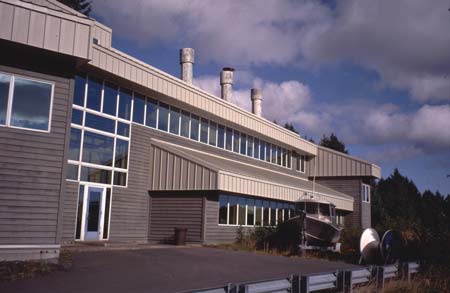
Along with representatives of Trident Seafoods and some surimi makers from the Faroe
Islands, an archipelago in the north Atlantic, employees of the Alaska Department
of Environmental Conservation also sat in on Lanier鈥檚 demonstration in Kodiak last
month.
Clynda Case, a DEC program specialist, watched as surimi washwater was put through
a process that involved changing its pH to extract the soluble proteins and fine particulates.
The processed water was then put through a centrifuge. The end result was a recoverable
protein product that could be made into surimi, muscle milk, cosmetic products, and
nutritional supplements, among other things. The remaining water was clear and free
of solids, making it a much more environmentally friendly discharge into the ocean.
鈥淚 think the idea is the processors would get a product that they would make a profit
on and also have less of an environmental impact,鈥� said Case.
Cutting down on environmental waste
Reducing the amount of waste going into the ocean would likely appeal to seafood processors.
Trident, for example, agreed to pay a $2.5 million civil penalty in 2011 for alleged
pollution violations at its seafood processing plant in Akutan. The pollution involved
large piles of fish waste on the ocean floor. As part of , the company agreed to invest millions in strategies to better control its fish waste.
Lanier said lowering the environmental footprint of surimi production was a motivating
factor behind the years he and his colleagues have spent developing the new protein-recovery
technology for the industry. But he also did it because he hated to see so much protein
going down the drain. He likened it to the cheese-making process, which produces whey.
It's used in many different products, including protein powders, nutritional drinks
and supplements 鈥� all part of a multi-billion-dollar global industry.
Lanier sees his protein-capturing surimi technology as an avenue for Alaska to capture
an additional $60 million to $80 million in new revenue annually from its surimi industry.
Chris Sannito, an Alaska Sea Grant seafood technology specialist, said he was encouraged
by what he saw and thinks others will be, too.
鈥淥ne of the plant managers told me they did some calculations and figured this technology
could recover $70,000 a day in lost revenue,鈥� said Sannito.
This article, by Alaska Sea Grant communications manager Paula Dobbyn, was first published
on the .