


Snow is the state of Alaska
March 11, 2021
Ned Rozell
907-474-7468
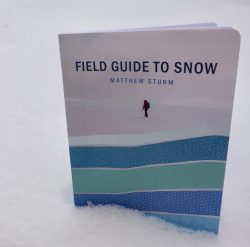
In mid-March, it is snowing once again in Fairbanks, as it has snowed on many days since October. That makes it a good day to pick up Matthew Sturm鈥檚 new book, 鈥淔ield Guide to Snow.鈥�
Sturm is a snow scientist at the 麻豆原创鈥� Geophysical Institute who has studied Alaska鈥檚 most common ground cover for decades. Many of his explorations are on long snowmachine traverses, undertaken about this time of year in the treeless Arctic.
Here are a few nuggets from 鈥淔ield Guide to Snow,鈥� published in 2020:
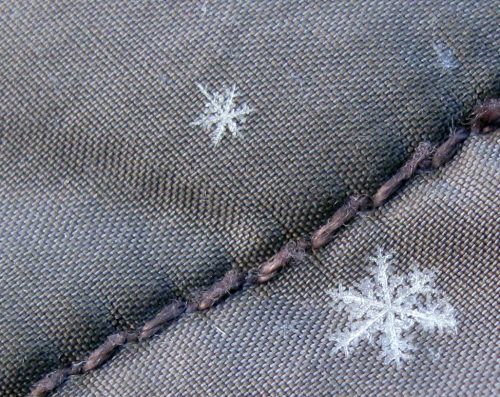
- Like people, most snowflakes are imperfect. At least 98 percent of snowflakes do not resemble symmetrical, six-pointed 鈥渟tellar dendrites.鈥� Most snowflakes are missing one or more arms. They can be shaped like pencils, bullets or arrowheads. Perfect stellar dendrites, the ideal snowflakes often featured in photos, have fallen to the ground with the good luck to have avoided mid-air collisions with other snowflakes.
- A typical snowpack is at least 50 percent air, but people can still suffocate when consumed by an avalanche: 鈥淒ue to the victim鈥檚 own body heat and moist breath, an impermeable icy barrier is soon created near the face, which cuts off the flow of air in the snow,鈥� Sturm wrote.
- Much of snow鈥檚 magic for play is due to 鈥渟intering.鈥� The passage of a snowmachine or a pair of skis, or a pounding by a stiff wind, cause snow crystals to fracture into small, sharp particles that bond together and hold on tight. Left behind are hard-packed surfaces, all due to snow鈥檚 propensity to set up, which sand does not have. 鈥淪intering 鈥榞lues鈥� the grains together,鈥� Sturm wrote.
- When a cold snap hits, frigid temperatures will not reach the bottom of the snowpack for a week. This is because so much air is present 鈥� up to 90 percent for fluffy new snow. 鈥淚t makes a fine insulating blanket, nearly as good as a down parka,鈥� Sturm wrote.
- More than 1 billion people rely on the water from snow they never see. 鈥淓ven in the largely snow-free areas of California like Los Angeles and San Francisco, people drink snowmelt water and get power from electrical turbines turned by snow water,鈥� Sturm wrote.
- On one remarkable day in Alaska, enough snow fell in one high valley to bury an NBA center to his eyeballs. The story follows:
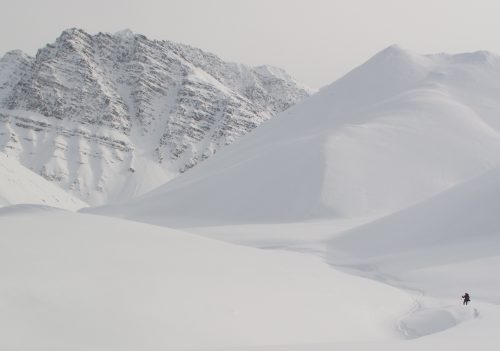
On Feb. 7, 1963, weather observer Ralph Lane recorded 78 inches of snow 鈥� that鈥檚 6.5 feet! 鈥� at Mile 47 of the Richardson Highway.
Mile 47 is just northeast of Thompson Pass in the Chugach Mountains, close to the confluence of Stuart Creek and the Tiekel River. In 1963, Lane was foreman of the Alaska Department of Highway鈥檚 Ernestine Camp, based at Mile 62 Richardson Highway.
While some weather researchers dispute the data from Mile 47, Alaska climatologist Brian Brettschneider once spoke to a scientist who had met the late Ralph Lane.
Lane told the man the snowflakes that day were large as silver dollars, and he had never seen snow that deep before. Lane also said he was caught in an avalanche that day while driving his snowplow.
Scientists who researched the claim of 6.5 feet of snow in one day could not produce enough evidence to overturn Lane鈥檚 measurement, so Alaska still holds the United States record for the most snow to fall in one day.
Since the late 1970s, the 麻豆原创' Geophysical Institute has provided this column free in cooperation with the 麻豆原创F research community. Ned Rozell is a science writer for the Geophysical Institute.