


麻豆原创 museum launches 'shAKe,' its first virtual exhibit
October 14, 2020
LJ Evans
907-474-2737
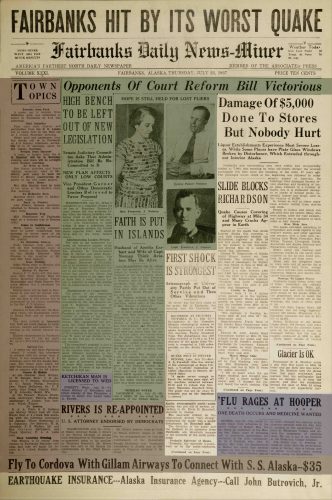
The headline across the top of the Fairbanks Daily News-Miner front page, bold and in all caps, said 鈥淔AIRBANKS HIT BY ITS WORST EARTHQ麻豆原创KE.鈥� Farther down the newspaper page, stories told about damage resulting from the earthquake, an ad offered earthquake insurance, and an article updated the search for missing pilot Amelia Earhart.
It was the July 22, 1937, edition.
Such headlines about earthquakes are not uncommon. Alaska is the most seismically active state in the U.S. with, on average, an earthquake every 12 minutes.
To acknowledge Alaska鈥檚 frequent earthquakes and their place in history, the Alaska Earthquake Center, 麻豆原创 Museum of the North and the News-Miner partnered this year to present the museum鈥檚 first virtual exhibit, 鈥渟hAKe: Earthquakes in Interior Alaska.鈥� The exhibit came online this month at www.uaf.edu/museum/exhibits/virtual-exhibits/shake-earthquakes/.
鈥淚鈥檓 excited to share stories of earthquake country, central Alaska, with the rest of the world,鈥� said Carl Tape, 麻豆原创F associate professor of geophysics and guest curator for the exhibit. Tape worked with the museum鈥檚 director of exhibits, Roger Topp, and museum staff, to deliver shAKe.
The exhibit includes high-resolution, optimized photographs of newspaper pages from 1904 to 2014, as well as news stories about major earthquakes in central Alaska, a 21-part online video tour of the physical exhibit and oral history interviews with Alaska Native elders about their earthquake experiences.
It also includes a free immersive app for Mac and Windows that contains almost all of the earthquake content. Through the app, users can virtually walk through a 3D model of the exhibit, explore Interior Alaska鈥檚 earthquakes and hear 麻豆原创MN visitors鈥� accounts of earthquake events from around the world.
鈥淭he 鈥榝irst virtual exhibit鈥� label is earned in large part from the architectural replication of the physical exhibit鈥檚 space and content,鈥� Topp said. 鈥淚t鈥檚 not a website so much as a multimedia architecture.鈥�
The shAKe physical exhibit was on display at the 麻豆原创 Museum of the North in 2018 and 2019. Through the new virtual, online format, it is possible to reach a much broader audience.
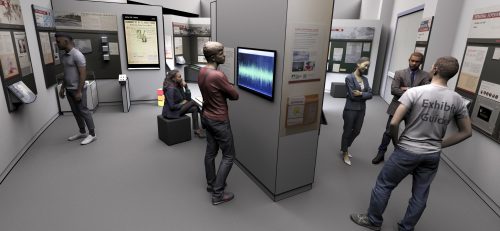
鈥淲e can offer the content in an interactive, archival fashion for an indefinite period of time, rather than the fixed duration of a physical exhibit,鈥� Tape said.
Tape, a researcher at 麻豆原创F鈥檚 Geophysical Institute, has been interested in earthquakes since he was a teenager growing up in Fairbanks. The idea for the exhibit came in 2014, when a magnitude 4.3 earthquake rattled the region and made front-page news. When he went to purchase a print edition of the News-Miner, the cashier was unaware that earthquakes were common here.
鈥溾�榊ou live in earthquake country,鈥欌�� Tape responded, surprised. 鈥淚 was struck by how few people in Alaska 鈥� and even in Fairbanks 鈥� were aware of the earthquake potential in central Alaska.鈥�
He wanted to bring the history of earthquakes to light and did so using the very newspapers which had informed local citizens about the news of the day. He saw an opportunity to fuse earthquake science with history.
However, newspapers are not the only records of seismic activity. Some earthquakes were felt by Native communities and their stories were recorded and are available in the virtual exhibit.
鈥淭heir stories serve as a reminder that, as a people, they have lived with earthquakes for thousands of years prior to the earthquakes featured in the exhibit,鈥� Tape said.
ADDITIONAL CONTACTS: Carl Tape, ctape@alaska.edu; Roger Topp, rmtopp@alask.edu, 907-474-6985